Case study: GenAI vs. illustrators - the battle of carbon
Tip
This case study is based on an academic publication.
This case study aims to show how the ecological benefits of digital technologies are often justified using highly criticisable quantitative assessments. It also illustrates how such techno-optimist narratives can be established through (pseudo)-academic publications.
A study
In 2024, a group of researchers working on the sustainability of ICT published an article called ‘The carbon emissions of writing and illustrating are lower for AI than for humans’. This paper was published in Nature Scientific Reports, a review journal that benefits from the well-known Nature brand but has a much lower scientific quality.
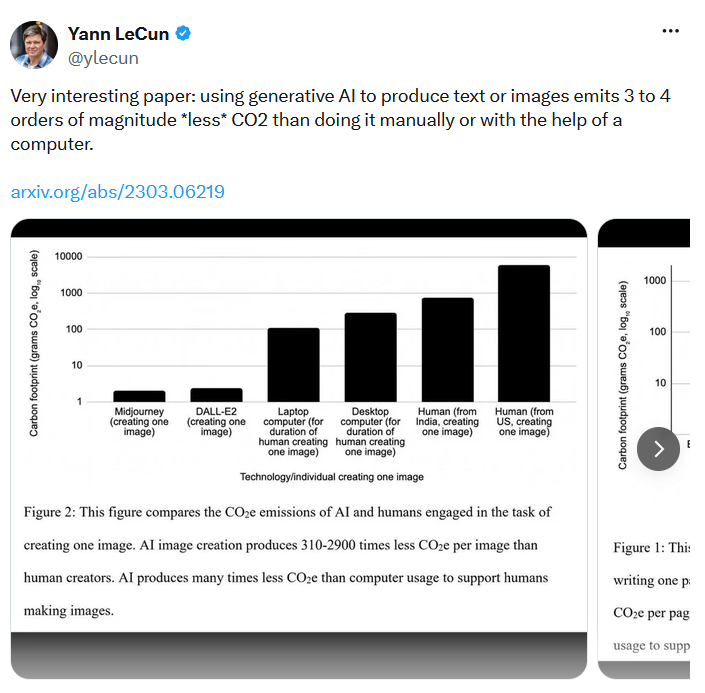
In this article, with a very transparent title, the author argues : “We found that, for these two activities [Writing and illustrating], at least, AI has a substantially lower carbon footprint than humans engaged in the same task”. In sum, to be sustainable, companies should use genAI instead of humans to produce their content.
An authority argument
That was all it took for this argument to become a key point cited by advocates of genAI. The following tweet by Yann LeCun, a Turing Award winner (the equivalent of the Nobel Prize in computer science) who at the time was Meta’s chief AI scientist, illustrates how the paper’s conclusions were used to defend the technology.
Counter-attack from academia
However, this study suffer some major methodological problems :
Fallacious counterfactual reasoning: Such ‘net impacts’ studies are comparative by design, they compare the carbon footprint of an LLM task with that of another (human-based) task. However, in this case, all the carbon footprint associated with humans was included, including feeding, housing and transportation. In other words, AI would truly avoid the impact of humans if illustrators and writers were to disappear.
Omissions : On the other hand, several impacts of AI were omitted from the analysis, including the embodied impacts of the materials used by the LLM (e.g. raw material extraction and purification, manufacturing, transport and disposal), or the technical environment in which the model is hosted.
Incorrect comparison: When comparing two processes, it is important to ensure that they produce similar outputs. However, Tomlison et al. (2024) considered that only one prompt was needed to generate an image or text of the same quality as human-based production, which typically requires several attempts.
Reductionism: While Tomlison et al. (2024) consider the beneficial indirect effects of deploying genAI to avoid the impacts of human-based tasks, they do not consider all the ripple effects induced by such an action. For example, even if prompting AI was more ecologically efficient, it has been documented that AI has increased the generation of illustrations by making them far more accessible. This is a classic example of a rebound effect.
This counter argumentation was point out by several publication published 2 years later. Correcting the main error of the publication without considering the indirects effects of AI, Cook et al. (2025) concluded that the net impacts of genAI use compare to human illustration or writing was highly sensitive to methodological choice and could be positive or negative depending on the accounting choices.
In a direct response to the paper sent to the editor by Bol et al. (?)… TBD
As you can see, it would have taken the academic community at least two years to publish a counter-study with as little hope of being heard as the original paper. Today, the original paper has been cited 169 times, while Cook et al. (2025) have been cited twice, and Bol et al. are still in the editorial process…
Resources
Syllabus
- Joseph Cook, Romain Jacob, Jo Lindsay Walton, Adrien Berthelot, Asim Hussain, et al. Beyond Counting Carbon: AI Environmental Assessments Struggle to Inform Net Impact Decisions. 2025.