Case study: Does Vinted help the environmental transition of the textile sector?
Tip
This case study is based on an academic publication.
Established in 2008 in Lithuania, Vinted is a leading second-hand clothing resale platform currently operating in Europe and Northern America. Beyond enabling cost savings for customers and additional income for vendors, the company emphasizes its environmental benefits as a key commercial argument. Vinted claims to reduce GHG emissions by encouraging the purchase of second-hand clothing thereby avoiding the production of new clothes. This assertion assumes that the emissions avoided compensate for the additional emissions due to the transport of parcels and the operation of the Vinted platform and organization.
In 2021, Vaayu, a consulting firm specialized in the environmental assessment within the textile sector, conducted a net impact study (focusing on GHG emissions) on behalf of Vinted. Based on a “net impact methodology” and using primary data collected through survey and transaction analysis, the study states that Vinted has avoided 453 kiloton CO2eq. in 2021. This figure is obtained by comparing, for each transaction, a scenario where items are purchased on Vinted platform with a scenario involving the acquisition of new items.
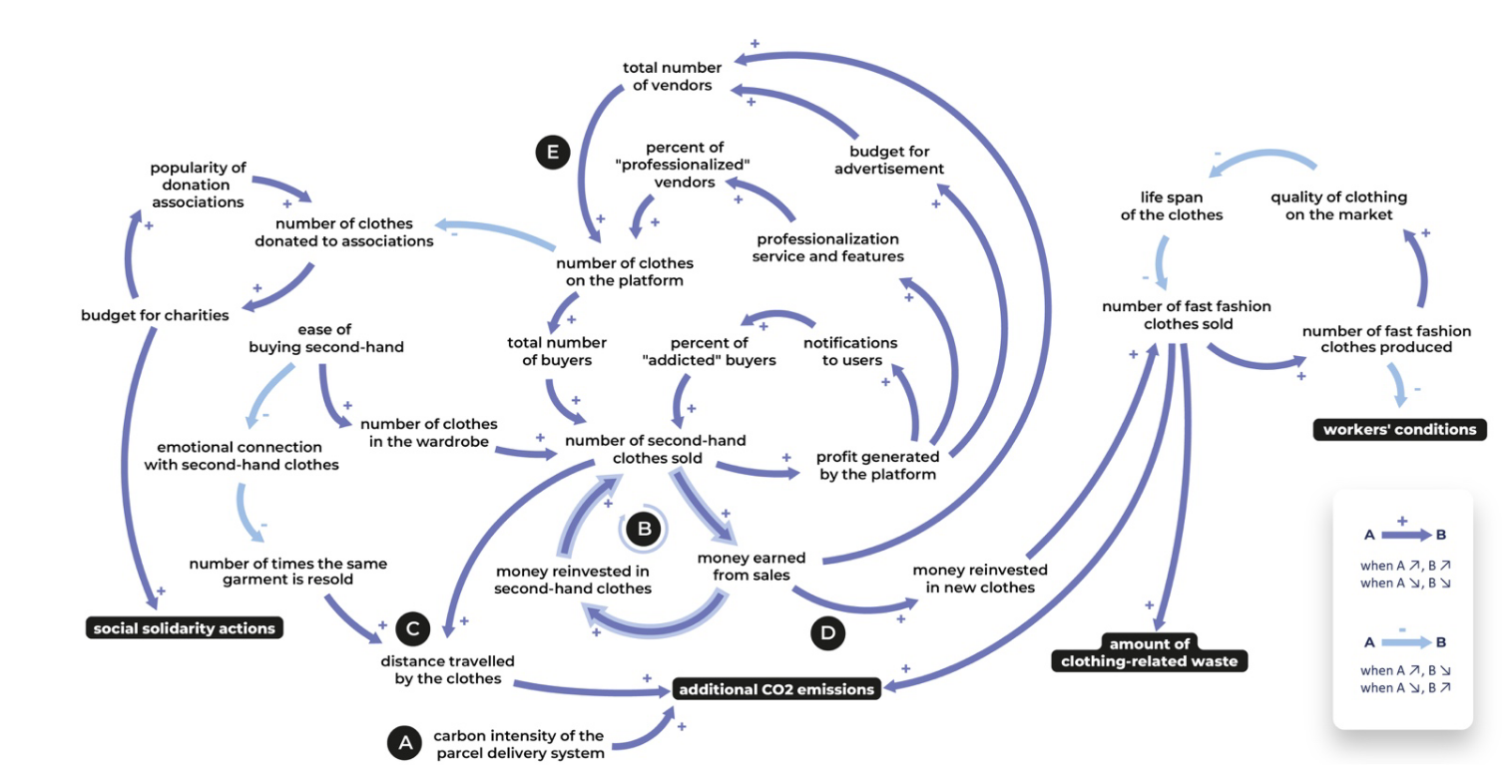
However, buying second-hand items doesn’t always displace demand for brand-new clothes. Indeed, Vinted creates new demand, whether because second-hand items are cheaper or because Vinted uses design patterns to encourage impulse buys. These effects could be referred to as ‘rebound effects’.
The study claims that these rebound effects were taken into account. In particular, they evaluated the proportion of purchases that could be considered ‘impulsive’ by asking customers if they would have bought the same item new if Vinted hadn’t existed.
However, several limitations appear in this study, hindering the quality of the results. Notably, significant documented effects were excluded from the analysis. One example is the reinvestment of money earned on Vinted through selling into fast fashion items, which fuels the vicious circle of the fast fashion industry. We could also mention social effects, such as the tremendous reduction in donations to charities induced by a change in customer behaviour from donating to selling, which has put those charities in great difficulty.
Ubiquitous digital platforms like Vinted also operate deep societal transformations that cannot be acknowledged by comparing scenarios at the scale of one transaction. For example, some scholars have noted a shift in some sellers’ practices towards a ‘consu-merchant’ (i.e. a blurring of the distinction between consumer and vendor).
Such criticism should encourage us to carefully scrutinise the tech companies’ claims and adopt a more systemic approach. This will enable us to acknowledge the dynamics induced by the deployment of such solutions in more depth, and make the most relevant decisions to encourage their beneficial effects and constrain the detrimental ones.